Tankless vs. Tank Water Heater: Which Is Right for Your NJ Home?
Licensed NJ Handyman
Handyman Near Me NJ · 25+ years
Key Takeaways
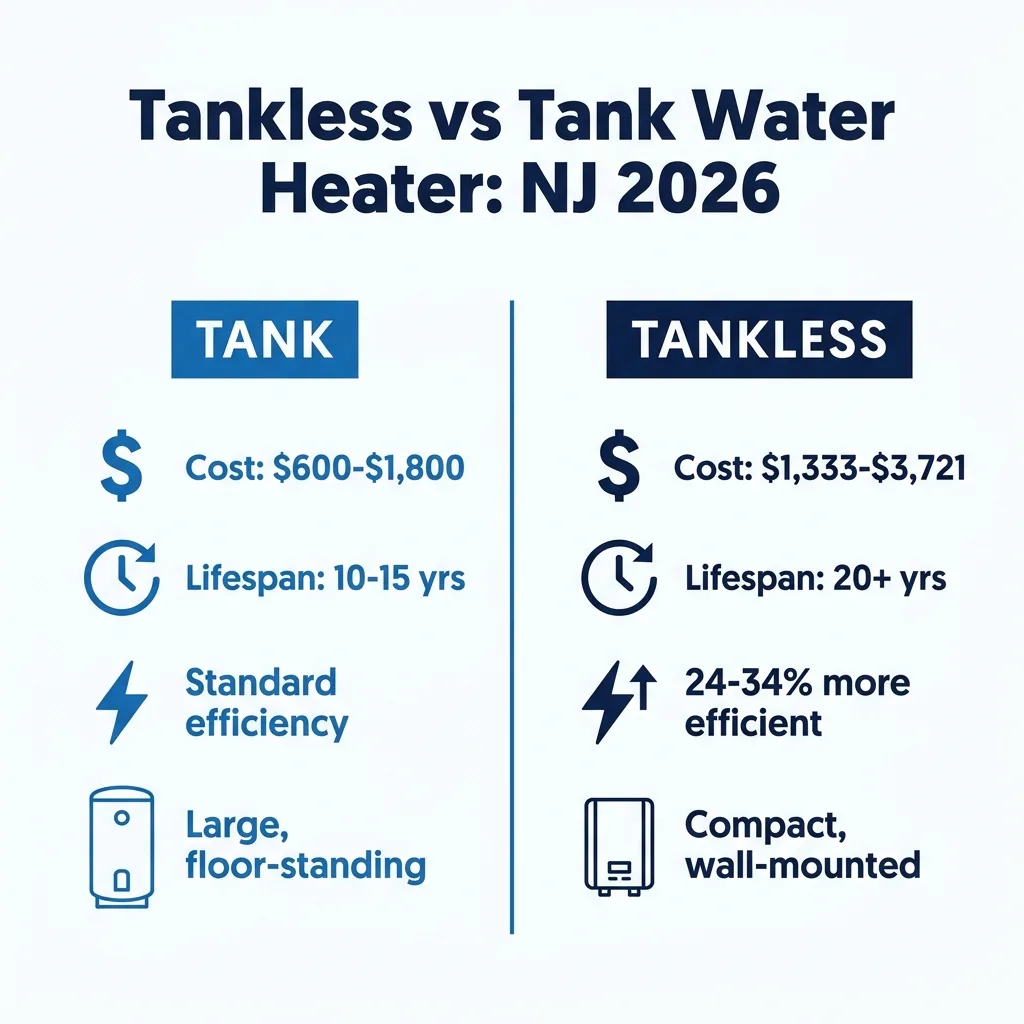
- Tankless water heaters cost more upfront ($1,333–$3,721 installed on average) but can be 24%–34% more energy efficient for households using 41 gallons of hot water per day or less.
- Tank water heaters cost less upfront ($600–$1,800 installed typically) and are simpler to replace, but they run continuously and have a lifespan of 10–15 years vs. 20+ years for tankless.
- In NJ, natural gas is the dominant fuel for both types. Electric tankless heaters often require a panel upgrade, which adds cost.
- Shore-area homes in Monmouth County with hard water need a water softener or scale filter if installing a tankless unit. Hard water scaling is the most common reason tankless heaters underperform or fail early in this region.
- The right choice depends on your household’s daily hot water usage, your current fuel type, your panel capacity, and how long you plan to stay in the home.
For most NJ homeowners, a tank water heater is the practical choice for a straightforward replacement. Tankless makes sense if you’re planning a longer stay, your energy bills are high, or you’re building or remodeling and want to optimize utility costs from the start.
Side-by-Side Comparison
Before getting into when each type wins, here’s the core comparison at a glance.
| Factor | Tank Water Heater | Tankless Water Heater |
|---|---|---|
| Upfront installed cost | $600–$1,800 typical | $1,333–$3,721 average |
| Energy efficiency | Standard | 24%–34% more efficient at low usage |
| Lifespan | 10–15 years | 20+ years |
| Hot water capacity | Limited by tank size (40–80 gal) | Continuous, but limited by flow rate |
| Recovery time | 20–60 min for a full tank | Instant, on demand |
| Space required | Large (floor standing) | Small (wall-mounted) |
| Fuel types in NJ | Gas or electric | Gas or electric |
| Panel upgrade needed? | Usually no | Often yes for electric models |
| Hard water sensitivity | Low | High; scale filter recommended |
| Permit required in NJ? | Usually yes | Usually yes |
| Best for | Most replacement jobs, shorter stays | Long-term owners, high energy costs |
When a Tank Water Heater Is the Better Call
A tank water heater wins in most straightforward replacement situations. If your current water heater is in the same location and on the same fuel type, a tank replacement is a same-day job. It doesn’t require a new gas line, a panel upgrade, or structural changes. The total installed cost is lower, and it works the same day it goes in.
In older NJ homes, this matters. Many West Long Branch, Long Branch, and Monmouth County homes were built in the 1950s through 1980s with standard 40- or 50-gallon gas tank heaters in a dedicated utility space. Swapping like for like is fast, affordable, and reliable.
Tank heaters also work well for households that use a lot of hot water at once. If three people are showering, laundry is running, and the dishwasher is on, a properly sized tank delivers hot water to all points simultaneously. A single tankless unit with an insufficient flow rate can’t always keep up during peak demand, a common complaint we hear from homeowners who made the switch without sizing correctly.
The downside is standby heat loss. A tank heater keeps 40–80 gallons of water hot continuously, even overnight when no one uses it. That constant cycling costs energy. Over a year, it adds up, especially in older units with thin insulation. A tank heater with a higher R-value insulation jacket reduces this loss, but it can’t eliminate it. The Department of Energy notes that models with higher insulation ratings significantly reduce standby heat loss compared to base-model units.
For more on plumbing-related replacements and what’s involved in a water heater swap, see our plumbing services page for West Long Branch.
When Tankless Wins
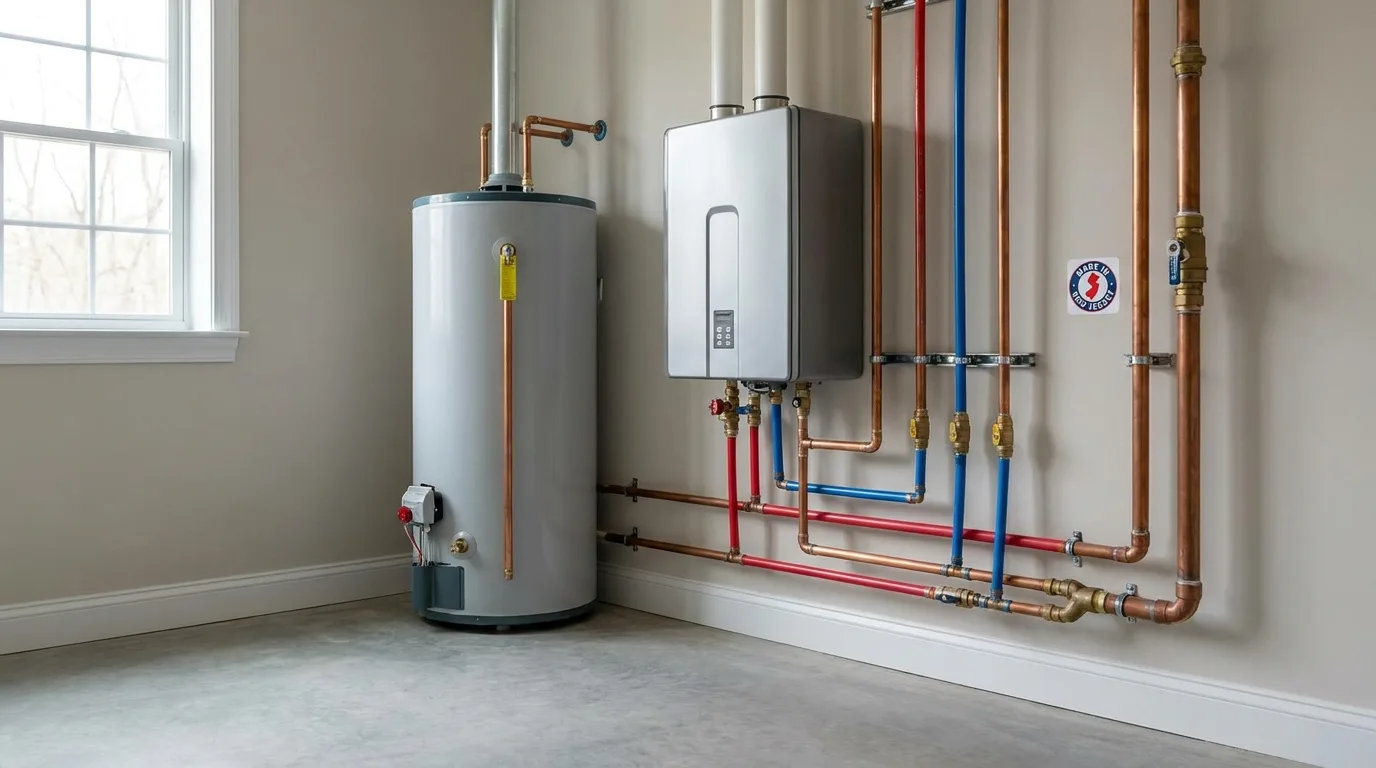
Tankless water heaters make a compelling case when you plan to stay in the home for many years, your current energy bills are a pain point, or you’re doing a full remodel where the utility room layout is flexible anyway.
The efficiency advantage is real. According to the Department of Energy, tankless units can be 24%–34% more energy efficient for homes that use 41 gallons or less of hot water per day. For heavier users, around 86 gallons per day, the gain drops to 8%–14%. Still meaningful over 20 years, but less dramatic.
The lifespan difference is also real. Tankless units routinely last more than 20 years with proper maintenance. A standard tank heater lasts 10–15 years. If you’re in a home you plan to keep and the current tank is due for replacement anyway, going tankless is a reasonable long-term investment.
The hot water never runs out. This is the appeal most homeowners cite. No cold shower for the fourth person in line. For a large household or a vacation property that goes from zero to full occupancy on a Friday night, on-demand hot water is genuinely useful.
The caveats for NJ homes are real, though. Electric tankless units typically require a 200-amp panel, and many older NJ homes run 100-amp or 150-amp service. A panel upgrade adds significantly to the project cost and should be factored into any side-by-side comparison with a gas unit. Gas tankless units avoid this problem but need proper venting and, in some cases, a larger gas line. Factor these costs into your comparison before deciding.
Hard water is the other NJ-specific issue. Monmouth County’s water supply varies by municipality, but many shore-area communities have hard water that causes scale buildup inside tankless heat exchangers. Without a water softener or an inline scale filter, a tankless unit can lose efficiency and fail within five to eight years, far short of its rated lifespan. This is the most common premature tankless failure we see locally.
Our team handles both types of installations. If you have questions about what your panel can support or whether your water supply needs treatment first, our electrical services team can assess panel capacity as part of the quote.
The Thing Most Comparisons Miss: Sizing
Most tankless vs. tank comparisons focus on efficiency and cost. They skip the step that determines whether the system actually works: proper sizing.
For a tank heater, sizing is simple: match the first-hour rating (FHR) to your household’s peak demand. A family of four typically needs a 50-gallon tank with a high FHR. Under-sizing causes cold water problems. Over-sizing wastes energy on standby heat.
For a tankless heater, sizing depends on the maximum simultaneous flow rate you need (measured in gallons per minute, or GPM) and the groundwater temperature. NJ groundwater in winter is significantly colder than in southern states. A tankless unit needs to raise that incoming water to 120 degrees (the standard delivery temperature), which requires more BTU capacity than the same unit would need in a warmer climate. A unit that works fine in Georgia may underperform in a New Jersey January.
A correctly sized natural gas tankless unit for a three-bathroom NJ home needs sufficient GPM capacity at the required temperature rise for simultaneous fixture demand. Undersized units deliver warm water instead of hot during peak demand, which is the most common complaint from new tankless owners.
This is not a DIY sizing exercise. The calculation involves your incoming water temperature, simultaneous fixture demand, fuel pressure at the meter, and venting configuration. Get it wrong and the system works poorly from day one.
The Permit Reality in Monmouth County
Water heater replacement requires a permit in most NJ municipalities. West Long Branch and neighboring towns follow the Uniform Construction Code, which classifies water heater replacement as a plumbing permit. The permit cost is modest and typically involves a single flat fee plus an inspection. An inspection follows.
Skipping the permit is not worth it. An unpermitted water heater can complicate a home sale, create liability if there’s a water damage event, and void the equipment warranty on some units. Pull the permit. It’s a minor cost and a straightforward inspection.
A licensed contractor in NJ pulls the permit as part of the job. If a quote doesn’t include permitting, ask about it explicitly. For context on what professional service calls typically involve, our home repair services overview covers how we handle permitted work in West Long Branch.
Your Next Step
Replacing a water heater isn’t a decision to make entirely on paper. The right choice depends on your home’s specific setup: panel capacity, gas pressure, current venting, water quality, and usage patterns.
Call or text (732) 400-4667 for a free assessment. We’ve handled water heater installations and replacements across West Long Branch and Monmouth County for 25+ years, fully insured and available 24/7. We’ll tell you what your home can support, what each option will realistically cost, and which one makes sense for your situation.
For related reading, see our blog post on warning signs your home needs electrical maintenance, which covers panel capacity signs to watch for, and our 24/7 emergency handyman services post for urgent water heater failures. For other cost guides in the Monmouth County area, our home repair services page outlines what’s included in a full service call.
Frequently Asked Questions
Why do plumbers not recommend tankless water heaters?
Some plumbers are cautious about tankless units because the installation is more complex, sizing errors are common, and hard water damage is a frequent issue. In areas with hard water, like parts of Monmouth County, an unprotected tankless unit can fail early. A well-sized, properly installed unit with a scale filter works reliably. The hesitation is about execution, not the technology itself.
What are the downsides to a tankless water heater?
Higher upfront cost ($1,333–$3,721 average installed), potential need for a panel upgrade with electric models, hard water sensitivity requiring a scale filter in NJ, and a “cold water sandwich” effect with some units where a brief burst of cold water occurs between uses. Proper sizing and setup address most of these.
Can I replace my 40-gallon water heater with a tankless water heater?
Yes, in most cases. The connection points differ, and you may need to update venting, gas line sizing, or electrical service depending on the model. In NJ, this work requires a plumbing permit. A direct swap is straightforward for a licensed installer.
Do pipes freeze with a tankless water heater?
The pipes themselves are at the same risk as with any water heater. What’s different is that some tankless units have a freeze protection mode that activates when the unit senses near-freezing temperatures, but this only protects the unit, not the supply pipes leading to it. Standard pipe insulation practices apply, especially in NJ homes with pipes running through unconditioned spaces like crawl spaces or garages.
Need a Hand?
Licensed Handyman in New Jersey
Same-day service · Free estimates · 25+ years in New Jersey
Call (732) 400-4667People Also Ask
Frequently Asked Questions
Why do plumbers not recommend tankless water heaters?+
Some plumbers are cautious about tankless units because the installation is more complex, sizing errors are common, and hard water damage is a frequent issue. In areas with hard water, like parts of Monmouth County, an unprotected tankless unit can fail early. A well-sized, properly installed unit with a scale filter works reliably. The hesitation is about execution, not the technology itself.
What are the downsides to a tankless water heater?+
Higher upfront cost ($1,333–$3,721 average installed), potential need for a panel upgrade with electric models, hard water sensitivity requiring a scale filter in NJ, and a "cold water sandwich" effect with some units where a brief burst of cold water occurs between uses. Proper sizing and setup address most of these.
Can I replace my 40-gallon water heater with a tankless water heater?+
Yes, in most cases. The connection points differ, and you may need to update venting, gas line sizing, or electrical service depending on the model. In NJ, this work requires a plumbing permit. A direct swap is straightforward for a licensed installer.
Do pipes freeze with a tankless water heater?+
The pipes themselves are at the same risk as with any water heater. What's different is that some tankless units have a freeze protection mode that activates when the unit senses near-freezing temperatures, but this only protects the unit, not the supply pipes leading to it. Standard pipe insulation practices apply, especially in NJ homes with pipes running through unconditioned spaces like crawl spaces or garages.