Water Line Repair Cost in NJ: 2026 Pricing for Main Line Repair and Replacement
Licensed NJ Handyman
Handyman Near Me NJ · 25+ years
Key Takeaways
- A spot repair on a residential water service line in NJ typically runs $1,500–$4,500. A full line replacement from the curb to the house runs $3,000–$9,000.
- The single biggest cost driver is not the pipe. It’s what sits on top of it: lawn is cheap to open, a paved driveway or a sidewalk and curb cut is not.
- In most Monmouth County towns the homeowner owns the service line from the curb stop to the house. The water utility owns the main in the street. That line determines who pays.
- Warning signs worth acting on: an unexplained jump in your water bill, a permanently soggy patch in the yard, dropping pressure at every fixture, or the sound of running water with everything shut off.
- Water line work requires a plumbing permit and inspection in NJ, and most towns require a licensed plumber to pull it.
A water line repair in New Jersey typically costs $1,500–$4,500 for a spot repair, while replacing the full service line from the curb stop to the house runs $3,000–$9,000. Those ranges sit alongside national water main repair cost data, with NJ trending toward the upper half because of labor rates, permit requirements, and the amount of hardscape most shore-area properties have between the street and the foundation.
If you’re seeing water where it shouldn’t be, this guide covers what the repair actually costs, what drives the number, and how to tell a service line problem from a leak inside the house.
What NJ Homeowners Actually Pay
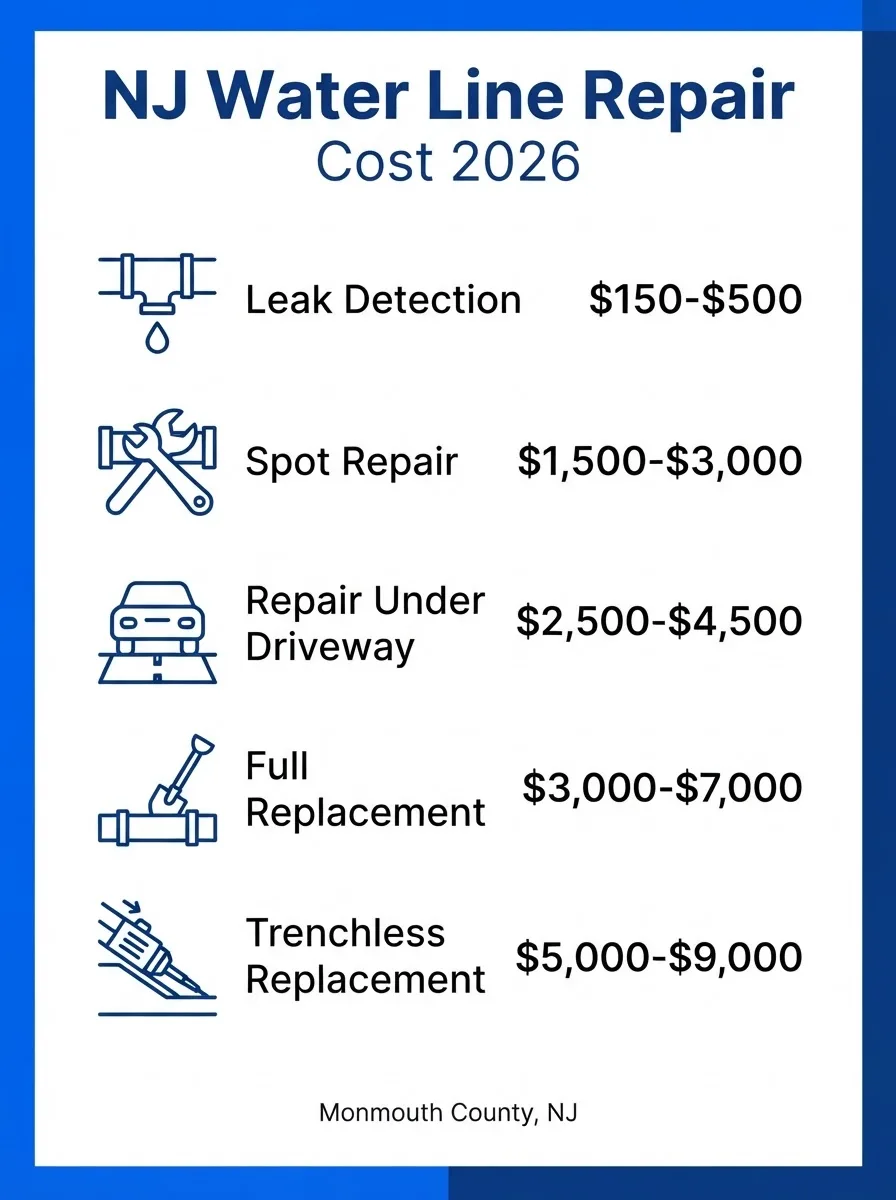
Here’s a realistic pricing snapshot for Monmouth County in 2026. These are professionally installed, permitted prices, not national averages.
| Job | Typical Cost Range | Notes |
|---|---|---|
| Leak detection / locate | $150–$500 | Often credited toward the repair |
| Spot repair (single break, open lawn) | $1,500–$3,000 | Excavate, cut out, couple in new section |
| Spot repair (under driveway or walkway) | $2,500–$4,500 | Add saw cutting and surface restoration |
| Full service line replacement (open trench) | $3,000–$7,000 | Typical 40–80 ft run from curb to house |
| Full replacement (trenchless / pipe bursting) | $5,000–$9,000 | Less surface damage, higher equipment cost |
| Curb stop or shutoff valve replacement | $600–$1,500 | Sometimes utility responsibility |
| Surface restoration (concrete / asphalt) | $500–$2,500 | Driveway aprons and sidewalks add up fast |
| Permit and inspection | $100–$300 | Required in most NJ municipalities |
Small variations in scope move these numbers a lot. A 30-foot run across open lawn and a 70-foot run under a paver driveway are the same plumbing job with wildly different price tags.
What Actually Drives the Cost
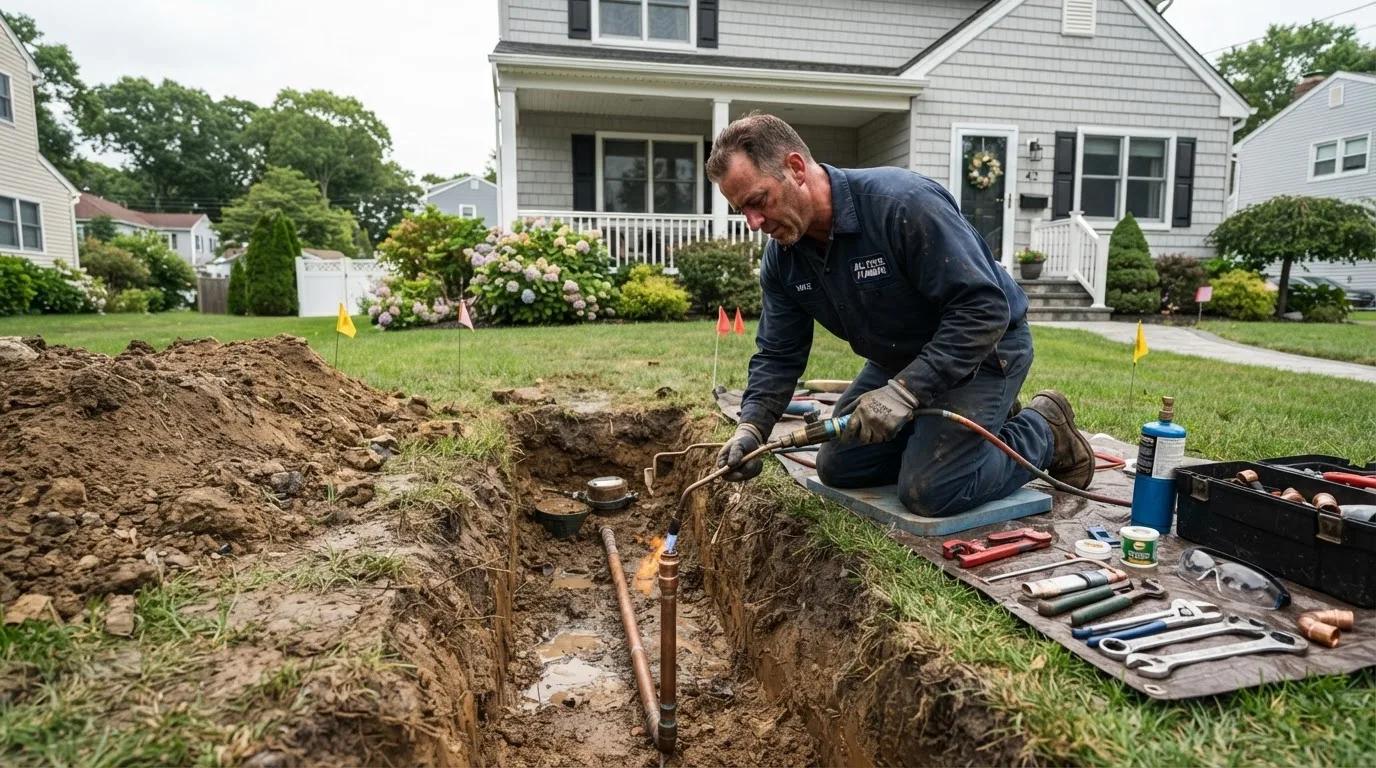
What’s on top of the pipe. This is the dominant factor and it surprises most homeowners. The pipe and fittings are a few hundred dollars. Opening and restoring a concrete driveway apron, a brick walkway, or a town sidewalk is where the money goes. A line running under open lawn is the cheapest possible scenario.
Length of the run. Homes set well back from the street have longer service lines, which means more trench, more spoil to handle, and more restoration.
Depth and the water table. NJ code puts service lines below the frost line, generally around four feet. Near the shore, in Monmouth Beach, Sea Bright, and low-lying parts of Long Branch, the water table can sit high enough that the trench needs pumping while the crew works. That adds time.
Pipe material and age. Older Monmouth County homes may still have galvanized steel or, in the oldest stock, lead service lines. Galvanized corrodes from the inside and chokes off flow. If a plumber opens the trench and finds galvanized or lead, a spot repair usually stops making sense and full replacement becomes the recommendation. New Jersey has been actively pushing lead service line replacement statewide, and some utilities cost-share on the replacement.
Open trench vs. trenchless. Pipe bursting or directional boring pulls a new line through without digging the whole run. The equipment costs more per job, but when the alternative is tearing out and repouring a driveway, trenchless often comes out even or cheaper overall.
Access. A tight side yard, mature trees with root systems over the line, or a fence line that has to come down all slow the excavation down.
Who Owns the Line, and Who Pays
This is the question that determines whether you’re looking at a $200 phone call or a $6,000 project.
In most Monmouth County municipalities, the water utility owns and maintains the main in the street plus the connection up to the curb stop, the shutoff valve usually located near the sidewalk or property line. Everything from the curb stop to your house is the homeowner’s service line, and it’s your responsibility.
That means:
- A break in the street is the utility’s problem. Call them first.
- A break in your yard between the curb and the foundation is yours.
- The curb stop itself is a gray area that varies by town and by utility.
Before you authorize any excavation, call your water utility and report the issue. They will often come out and check the meter and the curb stop at no charge, and they’ll confirm which side of the line the problem sits on. That call is free and it can save you thousands.
Some homeowners insurance policies and utility-offered service line protection plans cover part of this work. Check both before paying out of pocket.
Signs You Have a Service Line Leak
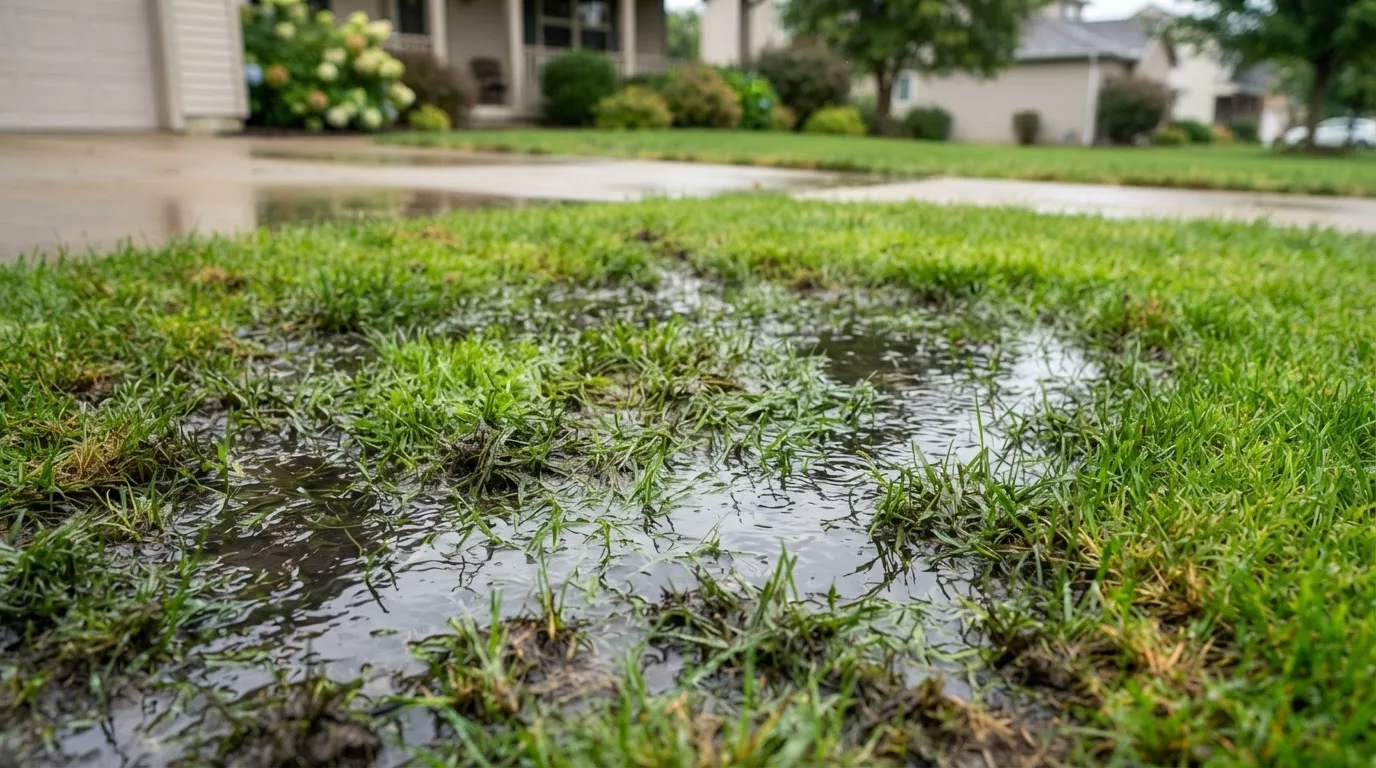
A buried leak rarely announces itself. These are the signals worth acting on:
A water bill that jumped with no change in usage. This is the most common first clue. A service line leak runs 24 hours a day, and the meter counts every gallon.
A wet or unusually green patch in the yard. Grass over a leaking line stays lush and soggy while the rest of the lawn dries out. In winter it may be the one spot that doesn’t hold frost.
Pressure dropping at every fixture in the house. A single slow faucet is a fixture problem. Low pressure everywhere at once points upstream to the service line. Our post on why a faucet drips even after tightening it covers the fixture-level version of this.
The sound of running water with everything off. Shut off every fixture and appliance, then listen at the main shutoff. A steady hiss or rush means water is moving somewhere it shouldn’t be.
The meter test. Shut off the main valve where the line enters the house, then check the meter’s low-flow indicator. If it’s still turning, water is escaping between the curb and that valve, which means the leak is in the buried service line.
If you’re not sure whether the leak is buried or inside the house, professional leak detection uses acoustic and pressure equipment to locate it without exploratory digging.
Repair or Replace?
A spot repair makes sense when the pipe is copper or modern plastic, in generally good condition, and the failure is a single identifiable break, often from ground shift, a rock, or a root.
Full replacement is the better call when:
- The pipe is galvanized steel or lead.
- You’ve already had two or more breaks on the same line.
- Flow is poor even with no active leak, which points to interior corrosion narrowing the pipe.
- The line is over 50 years old and the trench is already open.
That last point matters more than it sounds. Excavation is the expensive part of this job. If a crew is already in the ground for a spot repair on an aging galvanized line, replacing the whole run while the trench is open costs far less than coming back in two years to do it as a separate job.
Modern replacements typically use type K copper or HDPE, both of which have long service lives in NJ soil conditions.
Permits, Inspection, and Why They Matter
Water service line work requires a plumbing permit in essentially every NJ municipality, including West Long Branch, Long Branch, Sea Bright, and the surrounding towns, all of which operate under the Uniform Construction Code. The permit triggers an inspection of the connection and the backfill before the trench is closed.
Skipping it is a bad trade. An unpermitted service line can hold up a home sale, complicate an insurance claim if there’s a water damage event, and leave you with no recourse if the connection fails.
There’s also a call that comes before the permit: mark out utilities. New Jersey law requires contacting NJ One Call at 811 before any excavation so gas, electric, cable, and sewer can be located and marked. A licensed contractor handles this as a matter of course. It’s free, and hitting an unmarked gas line is the kind of mistake there’s no recovering from.
A licensed plumber pulls the permit and makes the 811 call as part of the job. If a quote doesn’t mention either, ask about it directly before signing.
What to Expect on the Day
A straightforward open-trench service line replacement is usually a one- to two-day job:
- Mark out (48–72 hours ahead, arranged before the work date).
- Excavate the trench from the curb stop to the foundation entry point.
- Pull or lay the new line, then connect at both ends.
- Pressure test and get the inspection before backfilling.
- Backfill and compact, then restore the surface.
Expect to be without water for several hours on the connection day. Lawn restoration is usually seeding or sod; hardscape restoration may be scheduled as a separate follow-up once the trench settles.
Your Next Step
If your water bill jumped, your pressure dropped, or there’s a patch of yard that never dries out, the first move is a diagnosis, not a shovel.
Call or text (732) 400-4667 for an assessment. We’ll run the meter test, locate the leak, tell you which side of the curb stop it’s on, and give you a real number for either a repair or a full replacement. We’ve handled water service line work across West Long Branch, Long Branch, Sea Bright, Monmouth Beach, and the rest of Monmouth County for 25+ years, licensed, insured, and available 24/7.
Next reads: first 5 minutes of a pipe burst, then the parent plumbing page — sewer line repair, drain cleaning, leak detection, water heater replacement. Those are the service URLs to use, not another town grid.
Frequently Asked Questions
How much does it cost to replace a water line to a house in NJ?
Full service line replacement from the curb stop to the house typically runs $3,000–$9,000 in New Jersey. Open-trench replacement across open lawn sits at the low end. Trenchless replacement, or any job requiring driveway or sidewalk restoration, pushes toward the high end.
Who is responsible for the water line from the street to the house?
In most Monmouth County towns, the homeowner is responsible for the service line from the curb stop to the house, and the water utility is responsible for the main in the street and the connection to the curb stop. Call your utility before authorizing work; they’ll confirm which side the problem is on at no charge.
How long does a water line repair take?
A spot repair on an accessible line is often a single day. Full replacement typically takes one to two days of active work, plus 48–72 hours ahead of time for utility mark out, plus separate scheduling if concrete or asphalt restoration is needed.
Does homeowners insurance cover water line replacement?
Standard policies usually exclude the buried service line itself, though they often cover resulting damage to the home. Many utilities and third parties sell separate service line protection plans that do cover it. Check both your policy and any utility plan before paying out of pocket.
What are the signs of a broken water line underground?
An unexplained spike in the water bill, a soggy or unusually green patch in the lawn, low water pressure at every fixture at once, the sound of running water with everything shut off, and a water meter that keeps turning after the main house valve is closed.
Need a Hand?
Licensed Handyman in New Jersey
Same-day service · Free estimates · 25+ years in New Jersey
Call (732) 400-4667People Also Ask
Frequently Asked Questions
How much does it cost to replace a water line to a house in NJ?+
Full service line replacement from the curb stop to the house typically runs $3,000–$9,000 in New Jersey. Open-trench replacement across open lawn sits at the low end. Trenchless replacement, or any job requiring driveway or sidewalk restoration, pushes toward the high end.
Who is responsible for the water line from the street to the house?+
In most Monmouth County towns, the homeowner is responsible for the service line from the curb stop to the house, and the water utility is responsible for the main in the street and the connection to the curb stop. Call your utility before authorizing work; they'll confirm which side the problem is on at no charge.
How long does a water line repair take?+
A spot repair on an accessible line is often a single day. Full replacement typically takes one to two days of active work, plus 48–72 hours ahead of time for utility mark out, plus separate scheduling if concrete or asphalt restoration is needed.
Does homeowners insurance cover water line replacement?+
Standard policies usually exclude the buried service line itself, though they often cover resulting damage to the home. Many utilities and third parties sell separate service line protection plans that do cover it. Check both your policy and any utility plan before paying out of pocket.
What are the signs of a broken water line underground?+
An unexplained spike in the water bill, a soggy or unusually green patch in the lawn, low water pressure at every fixture at once, the sound of running water with everything shut off, and a water meter that keeps turning after the main house valve is closed.