Water Heater Replacement Cost in NJ: 2026 Pricing for Repair vs. Replacement
Licensed NJ Handyman
Handyman Near Me NJ · 25+ years
Key Takeaways
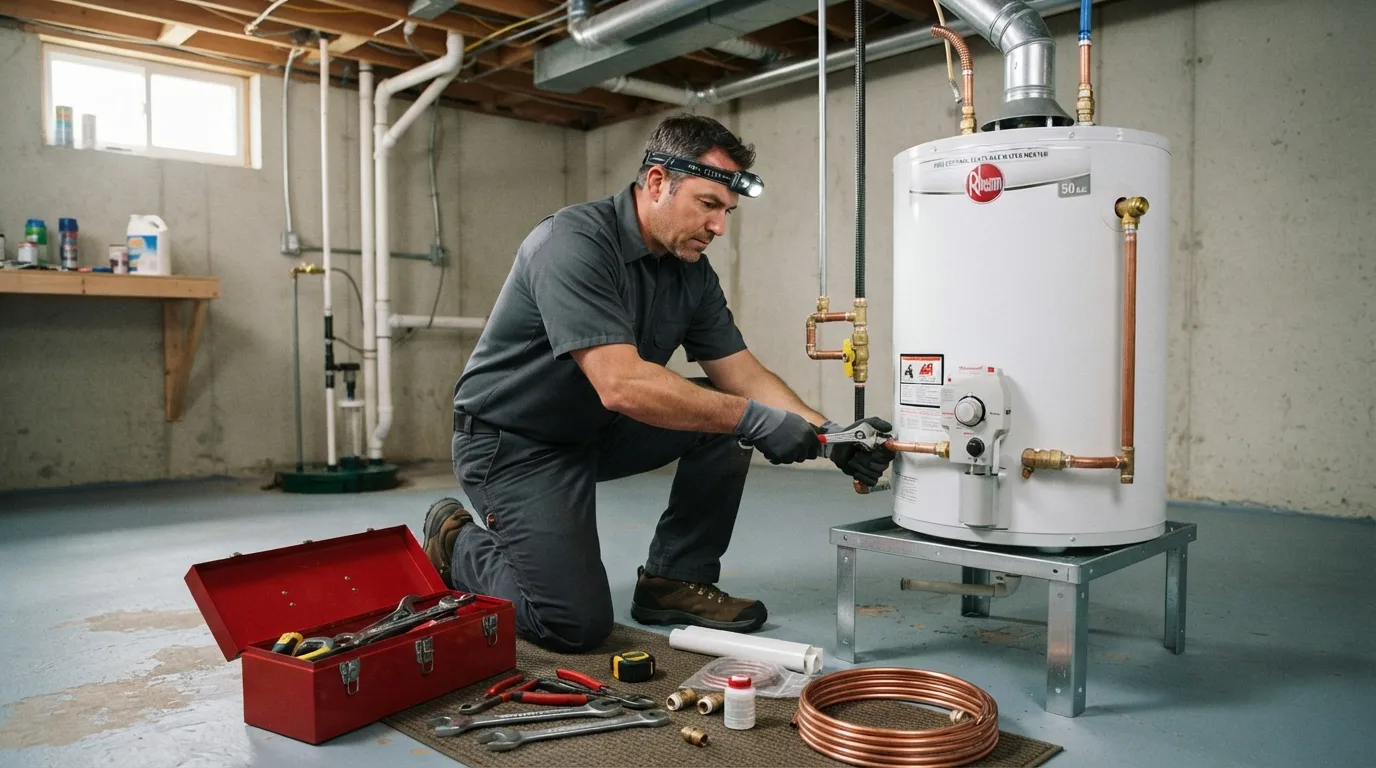
- Replacing a standard 40–50 gallon tank water heater in NJ costs $1,200–$2,800 installed, including permit, disposal of the old unit, and code-required updates.
- Common repairs run $150–$700. Thermostats, heating elements, and thermocouples are worth fixing. A leaking tank is not.
- The decision rule most homeowners need: if the tank itself is leaking, replace it. If a component failed and the tank is under 8 years old, repair it.
- Fuel type drives the price more than brand. Gas units cost more to install but less to run; electric units install cheaply but cost more monthly in NJ.
- Water heater replacement requires a plumbing permit and inspection in NJ municipalities. A licensed contractor pulls it as part of the job.
Replacing a water heater in New Jersey typically costs $1,200–$2,800 installed for a standard 40–50 gallon tank unit, with repairs running $150–$700 depending on the failed component. Those ranges align with national water heater installation cost data while reflecting NJ labor rates and permit requirements.
The harder question isn’t what it costs. It’s whether you should be replacing at all. This guide covers both.
What NJ Homeowners Actually Pay
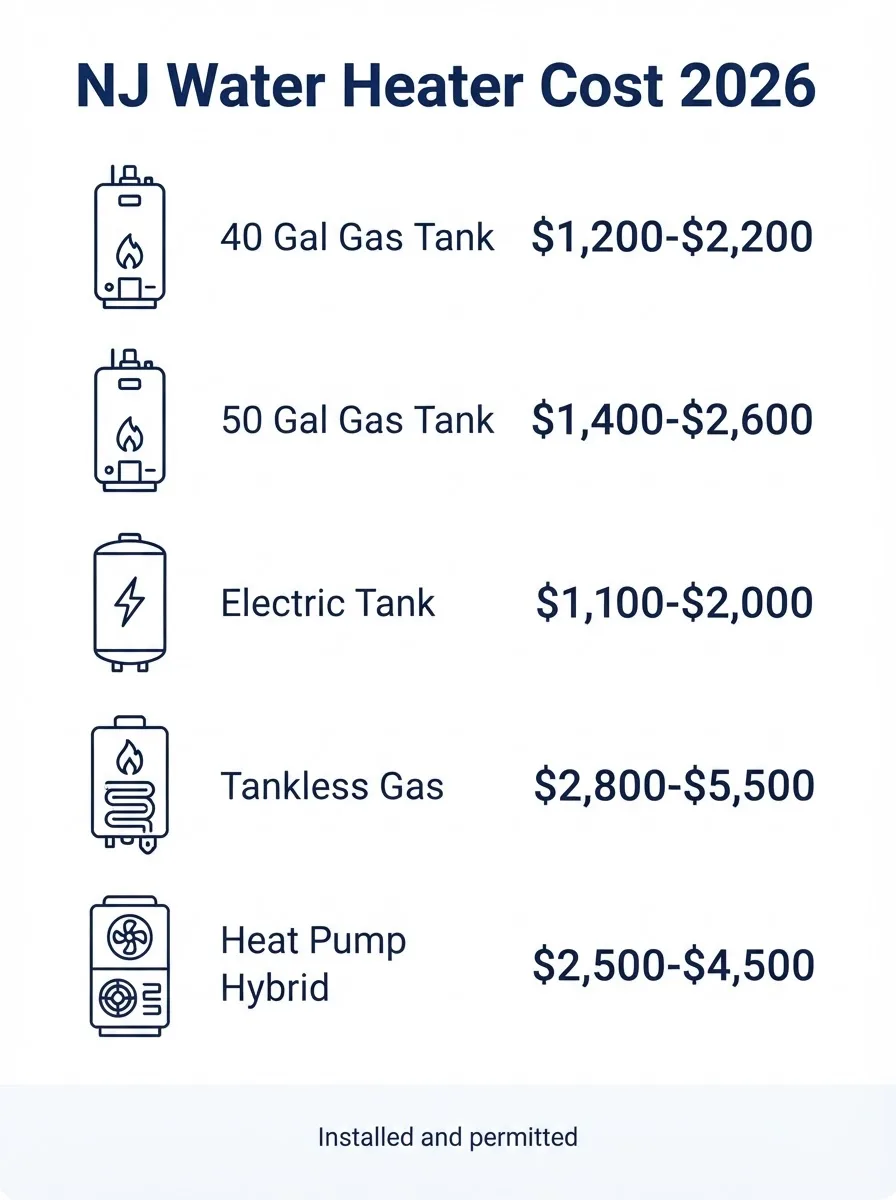
| Job | Typical Cost Range | Notes |
|---|---|---|
| 40-gallon gas tank, installed | $1,200–$2,200 | Most common single-family replacement |
| 50-gallon gas tank, installed | $1,400–$2,600 | Standard for 3+ bathroom homes |
| 40–50 gallon electric tank, installed | $1,100–$2,000 | Cheaper install, higher operating cost |
| Tankless (gas), installed | $2,800–$5,500 | May need gas line or venting upgrades |
| Heat pump / hybrid, installed | $2,500–$4,500 | Utility rebates often available |
| Thermostat replacement | $150–$300 | Common electric-unit repair |
| Heating element replacement | $200–$400 | Electric units |
| Thermocouple / gas valve repair | $150–$550 | Gas units, valve at the high end |
| Anode rod replacement | $150–$350 | Maintenance, extends tank life |
| Expansion tank (if code requires) | $200–$450 | Frequently added at replacement |
| Permit and inspection | $100–$250 | Required in most NJ towns |
Two line items catch homeowners off guard. Disposal of the old unit is usually bundled, but confirm it. And code-required updates at replacement, an expansion tank, updated venting, a drip pan, or a seismic-style strap, can add a few hundred dollars to a quote that looked simple over the phone.
Repair or Replace: The Actual Decision
Most of the confusion here comes from treating it as one question. It’s two.
Replace if the tank is leaking
Water coming from the tank body itself means the steel shell has corroded through. There is no repair for this. The glass lining failed, the anode rod is long gone, and the only path forward is a new unit. Waiting means a basement flood on the tank’s schedule, not yours.
Water pooling near the base is not automatically a tank leak, though. Check the fittings, the temperature and pressure relief valve, and the drain valve first. Those are repairable.
Repair if a component failed and the tank is young
Thermostats, heating elements, thermocouples, gas control valves, and relief valves are all replaceable parts. If the tank is under roughly 8 years old and holding water fine, a $250 repair is a much better use of money than a $2,000 replacement.
The gray zone: 8 to 12 years old
A standard tank water heater lasts 10–15 years, and shore-area water chemistry often pushes NJ units toward the low end of that. If your unit is 10 years old and needs a $500 gas valve, you are spending real money on an appliance with a couple of years left. That’s usually the point to replace.
Rule of thumb: if the repair cost is more than half the replacement cost and the unit is past 8 years, replace it.
The Monmouth County Water Problem
There’s a local factor that matters more here than in most parts of the country.
Much of Monmouth County has hard water, and the mineral content varies noticeably by municipality. Hard water accelerates two failure modes in a tank heater. Sediment settles at the bottom of the tank, where it insulates the burner from the water above it. The unit works harder, runs longer, and the bottom of the tank overheats. You’ll often hear this before you see it as a rumbling or popping sound during a heating cycle.
The second is anode rod depletion. The anode rod is a sacrificial metal rod that corrodes so the tank doesn’t. In hard water it depletes faster. Once it’s gone, the tank starts corroding, and the clock on replacement starts running.
Both are manageable with maintenance that almost nobody does: flush the tank annually and check the anode rod every three to four years. A $200 anode rod replacement at year six can add several years to a tank’s life. It is the single highest-return maintenance item on a water heater, and it’s the one most commonly skipped.
Salt air is a third factor for homes close to the water in Sea Bright, Monmouth Beach, and the Long Branch oceanfront. Exterior corrosion on venting, fittings, and the tank jacket shows up faster than it does inland.
Choosing a Replacement: Fuel Type and Size
Gas vs. electric. If your home already has a gas line to the water heater, replacing with gas is almost always the right call in NJ. The install costs more, but natural gas heats water faster and costs less per therm than the electric equivalent costs per kWh. Recovery rate matters too: a gas unit reheats a drained tank considerably faster than an electric one, which is what you actually notice on a busy morning.
Heat pump / hybrid. These use ambient air to heat water and are dramatically more efficient than standard electric. They need a reasonably large, unconditioned space, a basement usually qualifies, and they cool that space as a side effect. Utility rebates in NJ can meaningfully offset the higher purchase price. Worth pricing out if you’re on electric and have basement space.
Tankless. A bigger decision with real caveats around sizing, gas line capacity, panel capacity, and hard water. We covered that comparison in depth in our tankless vs. tank water heater guide for NJ.
Sizing. For tank units, match the first-hour rating to your peak demand rather than guessing on gallons. A family of four typically lands on a 50-gallon gas unit or a 66–80 gallon electric one. Undersize it and you get cold showers; oversize it and you pay to keep water hot that nobody uses.
Signs Your Water Heater Is Failing
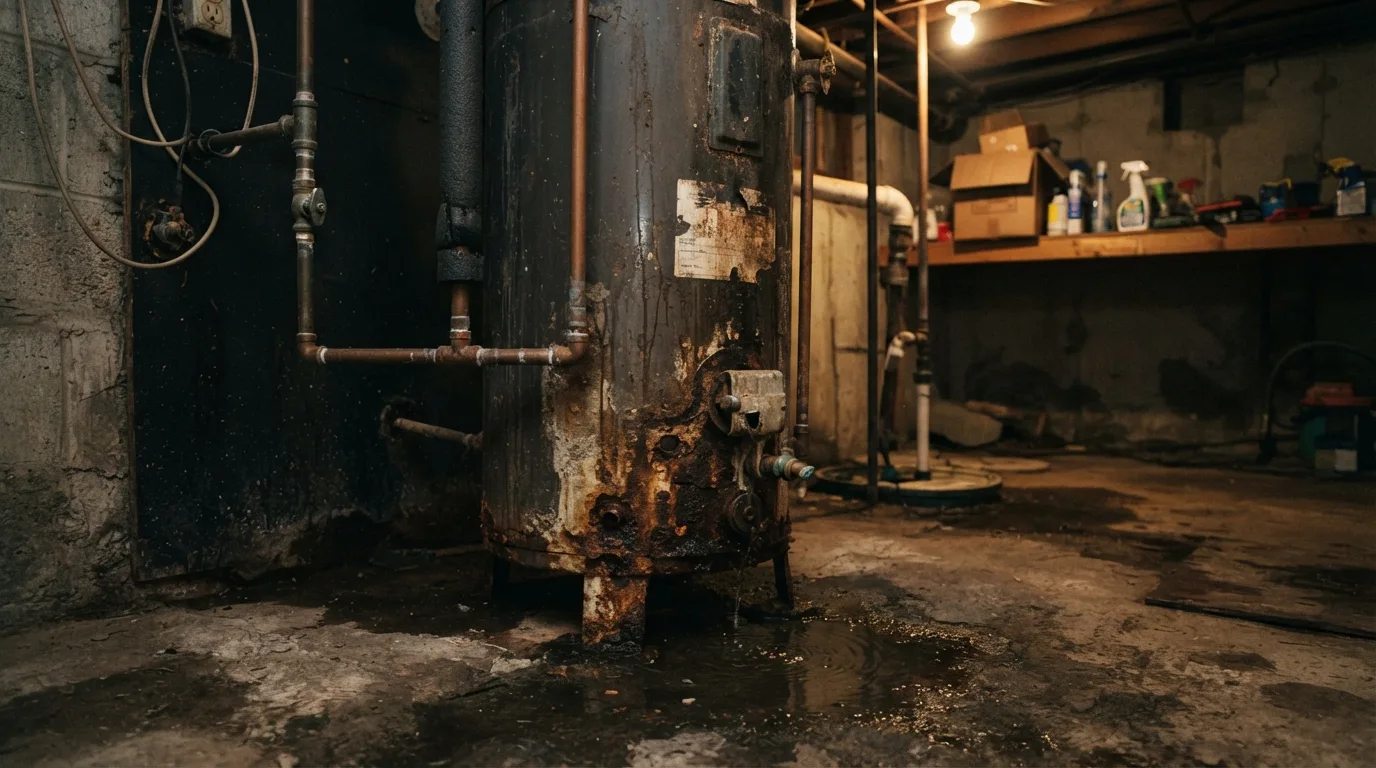
- Rusty or discolored hot water. Cold water runs clear, hot water runs brown. That’s the inside of your tank.
- Rumbling or popping during heating. Sediment buildup. Flush it now, and if it persists, the tank has been running hot for a while.
- Water at the base of the unit. Check fittings and the relief valve first, then assume the tank.
- Not enough hot water, or it runs out faster than it used to. Sediment is displacing capacity, or an element has failed.
- Age past 12 years with no maintenance history. Not a failure signal, but a strong replace-on-your-schedule signal.
That last point is worth sitting with. A water heater that fails on its own timeline usually does it as a leak, and a leaking 50-gallon tank in a finished basement causes far more expensive damage than the heater itself. Replacing a 13-year-old unit before it fails is cheap insurance.
Permits and Code
Water heater replacement requires a plumbing permit in essentially every NJ municipality. West Long Branch, Long Branch, Ocean Township, and the surrounding towns all operate under the Uniform Construction Code, which treats replacement as permitted work with an inspection.
The inspection checks the things that actually matter for safety: proper venting on gas units so combustion gases leave the building, a correctly installed temperature and pressure relief valve with a discharge line, and appropriate connections.
Skipping the permit can complicate a home sale, void the manufacturer’s warranty on some units, and create real liability if there’s a water damage or carbon monoxide event. A licensed contractor pulls it as part of the job. If a quote doesn’t include permitting, ask why.
Your Next Step
If your hot water is running short, your tank is rumbling, or you’ve got a unit past the ten-year mark, get eyes on it before it decides for you.
Call or text (732) 400-4667. We’ll tell you honestly whether you’re looking at a $250 repair or a replacement, what your setup can support, and what it costs installed and permitted. We’ve handled water heater replacement across West Long Branch, Long Branch, Sea Bright, Ocean Township, and Monmouth County for 25+ years, licensed, insured, and available 24/7.
For related reading, see our tankless vs. tank comparison, our 24/7 emergency handyman services post for after-hours failures, and our full plumbing services page.
Frequently Asked Questions
How much does it cost to replace a 50 gallon water heater in NJ?
A 50-gallon gas tank water heater typically costs $1,400–$2,600 installed in New Jersey, including the unit, labor, permit, disposal of the old heater, and any code-required updates like an expansion tank. Electric units of the same capacity generally install for less.
Is it worth repairing a 10 year old water heater?
Usually not, if the repair is significant. A standard tank lasts 10–15 years, so a 10-year-old unit needing a $500 gas valve is a poor investment. Small repairs like a thermocouple or relief valve are still worth doing. If the repair exceeds half the replacement cost, replace.
How long does water heater replacement take?
A straightforward like-for-like tank replacement is typically 2–4 hours. Switching fuel types, converting to tankless, or bringing venting and connections up to current code takes longer, sometimes a full day.
Why is my hot water running out so fast?
The most common causes are sediment buildup reducing usable tank capacity, a failed lower heating element on an electric unit, or a thermostat set too low. Increased household demand is also worth ruling out. A flush and an element or thermostat check usually identifies it.
Do I need a permit to replace a water heater in New Jersey?
Yes. Water heater replacement is permitted plumbing work under the NJ Uniform Construction Code in essentially every municipality, and it requires an inspection. A licensed contractor pulls the permit as part of the job.
Need a Hand?
Licensed Handyman in New Jersey
Same-day service · Free estimates · 25+ years in New Jersey
Call (732) 400-4667People Also Ask
Frequently Asked Questions
How much does it cost to replace a 50 gallon water heater in NJ?+
A 50-gallon gas tank water heater typically costs $1,400–$2,600 installed in New Jersey, including the unit, labor, permit, disposal of the old heater, and any code-required updates like an expansion tank. Electric units of the same capacity generally install for less.
Is it worth repairing a 10 year old water heater?+
Usually not, if the repair is significant. A standard tank lasts 10–15 years, so a 10-year-old unit needing a $500 gas valve is a poor investment. Small repairs like a thermocouple or relief valve are still worth doing. If the repair exceeds half the replacement cost, replace.
How long does water heater replacement take?+
A straightforward like-for-like tank replacement is typically 2–4 hours. Switching fuel types, converting to tankless, or bringing venting and connections up to current code takes longer, sometimes a full day.
Why is my hot water running out so fast?+
The most common causes are sediment buildup reducing usable tank capacity, a failed lower heating element on an electric unit, or a thermostat set too low. Increased household demand is also worth ruling out. A flush and an element or thermostat check usually identifies it.
Do I need a permit to replace a water heater in New Jersey?+
Yes. Water heater replacement is permitted plumbing work under the NJ Uniform Construction Code in essentially every municipality, and it requires an inspection. A licensed contractor pulls the permit as part of the job.